


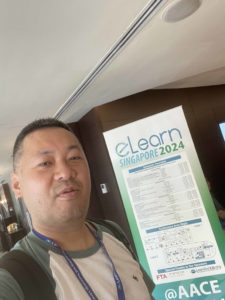
 I am not sure how many years it has been, but I attended eLearn 2024, an international conference organized by AACE. The host country was Singapore. Singapore is nice. It wasn’t as hot as I expected. Also, the one-hour time difference from Japan and the fact that it only takes about 6 or 7 hours to get there is great. Since I had surgery and have pain around my sacrum, I have trouble sitting for long periods, so this flight duration is helpful. However, there was an Indian temple next to the hotel, and the smoke from the incense drifted into the hotel, making me feel like I was choking. My throat is sore because of it…
Come to think of it, the last time I attended eLearn was in 2010. I haven’t attended since then. Also, due to the COVID-19 pandemic, international conferences themselves were not being held, so it felt like it had been a long time.
I have already described the content of my presentation in a previous article. It was the debut for Aiura-san (a first-year master’s student in the Graduate School of Information Science and Electrical Engineering), who co-presented with me, and it brought back memories of my own early days. I was in my second year of my master’s program when I first presented at ICCE. I think it was in Melbourne. I remember being in the same session as Professor Kashiwabara from the University of Electro-Communications. It’s nerve-wracking, isn’t it?
Aiura-san’s session itself went very well and was quite lively. I was wondering how it would be received overseas since it included details about the childcare situation in Japan, but there were quite a few international participants, and the discussion was very active. Aiura-san also said that participating this time has increased her motivation for research, so I am looking forward to her future work.
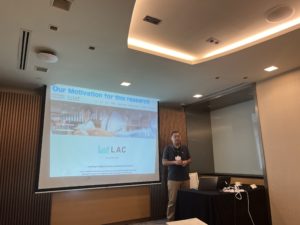 I gave two presentations with Dr. Geng, our specially appointed assistant professor. Dr. Geng is already a veteran, of course. Her English flowed smoothly, but perhaps because it had been a while and she was nervous, she kept her face pointed downward. We need to practice (laughs). That won’t do.
Here are a few things I felt…
・There were, as expected, many AI-related presentations. Many of the keynotes were also about AI. However, there was a lot of talk about pros and cons. As research progresses, such topics have become mainstream, so I feel like we’ve heard enough of that. I want to hear about the research itself.
・There were also quite a lot of VR, AR, and XR presentations. Depending on the research direction, this could really take off. Since content development is difficult and time-consuming, how to make this more efficient will likely become a research challenge as well.
・There were also quite a few game-related presentations. Along with content technology, there was a strong focus on how to increase learning engagement. I thought that was interesting.
・The number of participants was very low. Maybe 100 or fewer. When I was a student, AACE international conferences had so many participants and were so vibrant. It’s a shame. This decrease in participants feels like a result of rising costs everywhere, and the sense that if remote participation is fine, then that’s good enough for many people. There were also only about three corporate exhibitors.
Also, there were many participants from Japan. I met Dr. Li Kai (Dokkyo University), a classmate from my doctoral program, Professor Mitsuishi from Tohoku University (whom I just met in Sendai in September), Professor Takahashi from Tokyo Gakugei University (we talked a lot; it was fun), and Professor Ochi from Kindai University.
eLearn will apparently be in Singapore again next year. Two years in a row??? I will look at next year’s budget and see if I can take on the challenge.