


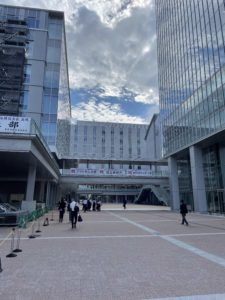
 On September 7th and 8th, I participated in the Japan Society for Educational Technology (JSET) 2024 Autumn National Conference held at Tohoku Gakuin University. It is a beautiful campus. This was my first time visiting. There are escalators inside the building!! It’s close to the station, too—how nice…
Upon entering the campus, I ran into many familiar faces. Professor Matsukawa from Tohoku University was the director in charge of the national conference, Professor Fukuyama from Kwansei Gakuin University and the executive committee members were providing navigation, and Professor Inagaki from Tohoku Gakuin University was also at the reception desk. I would like to thank the conference planning committee, the local executive committee, Professor Inagaki from the host university, and everyone at Tohoku Gakuin University. The venue was compact, spanning about two floors, which made moving around very easy. I really like it when things are that compact. It made navigation simple, and there was no need to assign so many people to guide attendees.
However, as someone who was a director in charge of the conference when we transitioned to holding two conferences a year (spring and autumn), I remember that the autumn conference was supposed to be held at external venues to save effort, especially since the number of participants is large. When I asked Professor Matsukawa about this in a casual conversation, he mentioned that they couldn’t find a venue (or perhaps it was too expensive to secure?). September is peak conference season, after all. Moreover, in a large city like Sendai that is close to Tokyo, convenience is high, so it must be popular. Besides JSET, there were several other academic conferences and even a jazz festival taking place. Furthermore, Ado happened to be holding a concert on Sunday, so Sendai was packed with events. Under such circumstances, it was very fortunate that we were able to secure Tohoku Gakuin University. I am grateful to Professor Inagaki.
I felt that recently, a wider variety of people have started presenting at JSET. While there were, of course, many active researchers from long-standing universities in Educational Technology such as Waseda, Tokyo Gakugei, UEC, Tokyo University of Science, and Kumamoto University, there were also presentations from researchers at universities I hadn’t seen much at national conferences before, which made for a lively atmosphere. Poster sessions are great for networking, and since Educational Technology has always had a “welcome all, force none” (laughs) attitude, I think this casualness is a good thing. It was great to see such a huge success.
As for the presentations, three members from our laboratory gave talks.
Three presentations at the JSET 2024 Autumn National Conference
https://mark-lab.net/3709
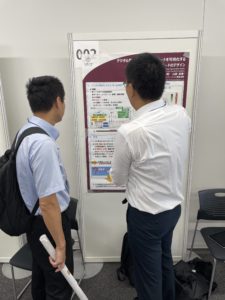
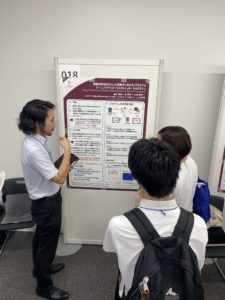
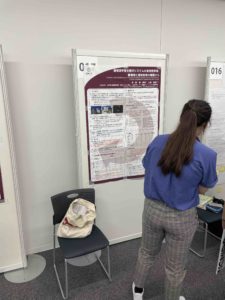 Everyone presented proactively. Thank you to everyone who listened to our talks. I believe we had good discussions, so we will take these back and apply them to make our research even better.
One of our members also attended the “Young Researchers’ Social Gathering” and seemed to have a great time. As someone who used to be a representative organizer for that gathering a long time ago, I am happy to see that such a community still continues today. I truly hope that these networking opportunities will persist.
I also spent time running around to listen to various presentations. As always, there are many on generative AI… It feels like research on generative AI is starting to branch out. There is a variety, ranging from research that re-examines or utilizes LLMs based on their characteristics, to more practical applications (assuming ChatGPT is a given) rather than pure research. Whether it can be elevated to the level of research depends on how the researcher understands generative AI, what kind of problems they apply it to, how they intend to achieve breakthroughs compared to conventional methods, and how they evaluate it—it comes down to whether these aspects are well-organized or not. I think having a clear perspective on these points is crucial. This is true regardless of whether it’s about generative AI or not.
Personally, as research on generative AI increases, my interests naturally gravitate toward literacy-related or data-utilization-type research, so I went around listening to those talks as well. It was a great learning experience.
On my way home, I met Professor Akahori, my mentor from my graduate school days. He said to me, “You’re publishing a lot of papers and working hard!” It made me very happy to know that he is keeping an eye on my research. Talking to Professor Akahori always gives me energy! I want to continue working hard to produce good research. National conferences are fun because you can meet so many people after a long time. It encourages me to keep doing good research!
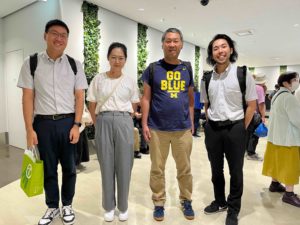 And finally, with the members at Fukuoka Airport.
I look forward to your continued support.
Oh, one last thing. I felt the poster session time was a bit short. 50 minutes… I suspect the number of presentations was higher than expected. It is very pleasing that the Japan Society for Educational Technology is thriving, but it is a question of how to manage this in the future. Perhaps creating spaces for interaction afterward will become important.