Development and Evaluation of a VR-Based Support System for School Nurse Training Integrated with Generative AI 2025–
In this research, we have implemented a VR-based support system for training school nurses, who work to improve the physical and mental health of students. Specifically, we have modeled the characteristics of students whose mental state is not ideal, based on the opinions and records of experts with extensive experience as school nurses, and have integrated this into a generative AI. Students in school nurse training programs use this system to convert their spoken input into text, which is then sent to the generative AI; the AI's response is then converted into speech via TTS and delivered by an avatar. In professional development, where creating authentic situations is crucial, this system reproduces such scenarios to facilitate effective learning.
This is a joint research project led by PI Prof. Xuewang Geng of Sojo University, in collaboration with Prof. Li Chen of Osaka Kyoiku University and Prof. Eto of Seinan Jo Gakuin University. This research was selected as a Best Full Paper Nominee at ICLEA 2026 and received the Excellence Award at the Learning Innovation Grand Prix.
Development and Evaluation of a VR System to Support the Acquisition of Picture Book Reading Skills (2024–)
This project utilizes Virtual Reality (VR) to support the acquisition of picture book reading skills in childcare worker training—a skill that is time-consuming and requires significant technique to master. Even if one understands the knowledge through experience or textbooks, embodying that knowledge in an actual field setting is a different matter. Educational Technology research has long explored the relationship between declarative and procedural knowledge, and various methods have been studied to support the acquisition of knowledge and skills applicable in the field. In this research, we use VR to have users read picture books to child avatars, and provide feedback based on multimodal data collected via sensors, such as gaze, voice volume, and head orientation.
We hope this will bridge the gap between what is learned in class, practical training, and the actual field, thereby enhancing readiness. This research is being conducted as a joint project with Professor Masaki Fukushima of the Graduate School of Information Science and Electrical Engineering and the Smart Learning Design Research Unit of the DX Promotion Headquarters, his student Wataru Aiura, the Fukuoka City Board of Education, and Fukuoka Municipal Fukuoka Girls' High School.
Development and Evaluation of a Learning Analytics Platform Including Learning Material Distribution Functions 2022–
In Learning Analytics research, dashboard research has become a major field, but it is not enough to simply use various algorithms to create dashboards, evaluate them, and improve practice. Dashboards exist only because there are platforms or content delivery infrastructures where original learning activities take place, such as Learning Management Systems, and they merely visualize the activities within those underlying systems. When you think about it carefully, there are many aspects that cannot be addressed without considering the design of the original platforms, such as Learning Management Systems or content delivery infrastructures. Often, as Learning Analytics progresses and key learning behaviors become visible, it becomes necessary to rethink the platforms themselves.
However, in reality, Learning Analytics is often conducted with the platform as a given, and it is quite difficult to modify the platform itself.
This research focuses on that point, and the key lies in thinking in the opposite direction, rather than just conducting one-way research that involves creating dashboards to visualize learning behaviors on a platform. The goal is to develop and evaluate a foundation that can drive a cycle of improving Learning Analytics by considering and improving the design of the infrastructure based on outcomes from Learning Analytics research that represents dashboard development and evaluation, and to construct a dashboard design model that supports Learning Analytics. This research is being conducted as a JSPS KAKENHI Grant-in-Aid for Scientific Research (A) project led by Professor Yamada.
Development and evaluation of learning analytics infrastructure including learning material delivery functionality 2022-2025
Dashboard research has become a major field in learning analytics research, but it is not enough to just create and evaluate dashboards using various algorithms. A dashboard is merely a visualization of the actions within that larger platform or content delivery infrastructure, such as a learning management system, where the original learning actions take place. There are many points that cannot be done without considering how the original learning management system, content delivery infrastructure, and other platforms should be designed, and there are many cases the platform itself needs to be reviewed when learning analytics is advanced and key learning behaviors become visible. However, in reality, learning analytics is often conducted with the platform in mind, and it is not always possible to modify the platform itself.
The point of this project is to focus on this point and to think about the opposite, rather than conducting unidirectional research to simply create dashboards that visualize learning behaviors on the platform. Think about how the design of the infrastructure should be, based on the results of learning analytics-related activities that represent dashboard development and evaluation, and then improve it, developing and evaluating an infrastructure that can turn the cycle of making learning analytics better and supporting learning analytics. The objective is to develop a dashboard design model that supports learning analytics. This research is supported by JSPS Grant-in-Aid for Scientific Research, Kiban Kenkyu A (general), under the direction of Dr. Yamada.
Development and evaluation of a learning dashboard to support decision making for learning behaviors 2021-2023
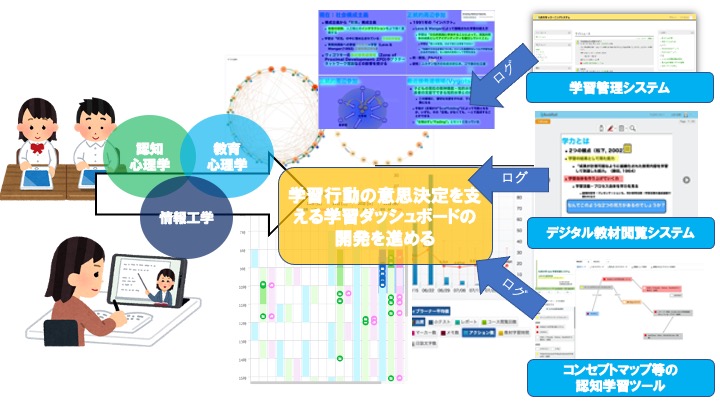
I believe that the decision to learn or not to do so ultimately depends on the each learner. From primary and secondary education, teachers have been providing various interventions for learners’ learning, but in the end, it is the learner’s problem to decide whether or not to learn and to act on it. But It is the desire of teachers to support learners’ decision-making and promote self-regulated learning. This research project aims to design, develop, and evaluate a learning dashboard that activates metacognition, one of the elements that support learners’ decision-making. This research is funded by the JSPS Grant-in-Aid for Scientific Research, International Collaborative Research Acceleration Fund (B), in collaboration with Dr. Stephanie Teasley, University of Michigan.
Definition of educational data literacy and construction of a model for its development 2021-2024
In recent years, the development of learning dashboards and other tools that utilize the vast amount of learning logs accumulated in learning support systems has been underway. This is an active research field, and has been a major topic at the Learning Analytics and Knowledge (LAK) conference, an international conference specializing in learning analytics. It is good to visualize the results of analyzing learning logs, such as dashboards, and provide feedback to learners and faculty, but it is the learners, faculty, or users who look at the visualized results and think about what to do with them. The purpose of this research is to organize the elements of the abilities related to educational data literacy and to construct a model for developing such abilities.
Research funded by JSPS Grant-in-Aid for Challenging Exploratory Research (Pioneering Research) (I will serve as the PI)
Develop a feedback infrastructure that blends data-driven and knowledge-driven 2020-2023
Learning environments that take advantage of information and communication technologies have become widespread in recent years, and systems that fully utilize AI to support learning are also emerging. One of the key elements of learning support is feedback. Feedback on how learners have learned and what they should do in the future will change the face of learning. However, looking at the field of education and learning to date, teachers and other educators and learning supporters have provided feedback, and feedback provided by experienced educators is of high quality and will undoubtedly lead to better learning in the future.
This research is an attempt to integrate not only data-driven feedback by information and communication technology, but also knowledge-driven feedback by theory and experience. The empirical environment is a seminar-like small group learning environment where various types of feedback occur.
This research is being conducted as a JSPS Grant-in-Aid for Scientific Research, Grant-in-Aid for Scientific Research B (led by Dr. Yoshiko Goda, Kumamoto University).
Developing a Learning Analytics Platform Using Educational Big Data 2016-2020
The use of ICT is gaining acceptance and popularity in education, and a major benefit of using ICT is the ability to record learners’ learning activities. By utilizing this record, it is possible to derive information such as where learners are stumbling, how they are learning, and when they are learning, and to provide optimized learning support for each learner. In addition to learning support, it is also expected to improve teacher-led classes by providing feedback to instructors on the results of analyzing the learning records of students in the class. This field of research is called learning analytics, and it is spreading worldwide. The goal of this research is to develop and evaluate a learning analytics platform that connects primary, secondary, higher and adult education. Dr. Ogata (Kyoto University) is the Principal Investigator (Grant-in-Aid for Scientific Research on Innovative Areas, S), and I am involved in this research as a sub-researcher.
Project Learning Support System for Visualizing Social Presence
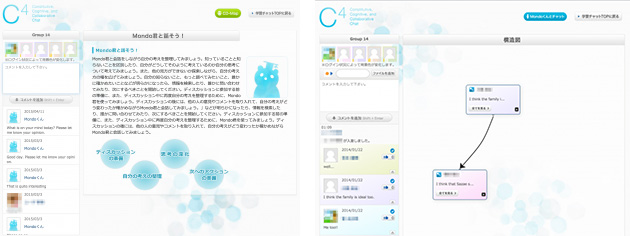
Social presence is simply defined as “the sense of being aware of or being made aware of the presence of another person in front of you” even in computer-mediated communication (CMC), where the other person is not visible to you. While humans communicate face to face by incorporating their own emotions, such as facial expressions and tone of voice, it has been said that this is difficult to do in situations where the other person is not visible, such as in text-based CMC. However, since the early 1990s, in the field of social psychology, research about social presence in CMC was activated, and some of those research shows that social behavior, such as the relationship establishment, takes place through emotional communication even in CMC. In the late 1990s, some of research began to present that social presence is strongly related to the uttered content, and there is a growing view that even in e-learning, the strength of social presence depends on the uttered content. Social presence is said to have an educational effect on forming a good group, especially in group learning such as cooperative learning, as well as on cognitive activities related to learning. C4α extends “C4″, a system developed in past projects, by extracting only those statements that are related to social and cognitive presence, and then visualizing the situation within the group. The system also aims to support active project learning by providing a concept map creation tool, a chat tool to support social presence comments, a tool to grasp the login status of the other party, and a project management tool to manage tasks within the group. The system in this project is also being developed as a plug-in for Moodle. Collaborative research funded by Grant-in-Aid for Scientific Research.
Past Projects
Project-Based Learning Support System for Visualizing Social Presence “C4α”, "CQCHAT" 2010-2021
In short, social presence refers to "the sense of having another person present, or the ability to make others feel that presence," even in Computer-Mediated Communication (CMC) where the other party is not visible. In face-to-face interactions, humans communicate by weaving in their emotions through facial expressions and tone of voice; however, it was traditionally said that this was difficult in situations where the other party is invisible, such as in text-based CMC. However, since the early 1990s, this has been actively researched in the field of social psychology, and research findings have emerged showing that social behaviors, such as the formation of human relationships, occur even in CMC through emotional communication. In the late 1990s, research also appeared suggesting that social presence is strongly related to the content of remarks, and in e-learning, the view that the strength of social presence depends on the content of remarks has become more prevalent. It is said that social presence affects the formation of good groups in learning, especially in group learning such as collaborative learning, and also influences cognitive activities related to learning. In C4α, we extend the "C4" system developed in past projects to extract only those elements related to social presence and cognitive presence from the content of remarks, thereby visualizing the situation within the group. Furthermore, as learning support, we aim to support active project-based learning by providing a system linked with a concept map creation tool, a chat tool that supports remarks related to social presence, a tool to grasp the login status of others, and a project management tool for managing tasks within the group. The system developed in this project is also being developed as a Moodle plugin. This is a joint research project funded by KAKENHI (Grant-in-Aid for Scientific Research (B)) led by Professor Yamada.
Development of a Feedback Infrastructure Blending Data-Driven and Knowledge-Driven Approaches 2020–2023
While learning environments utilizing information and communication technology have become widespread in recent years, systems that fully leverage AI to support learning are also emerging. One key element in providing learning support is feedback. By providing feedback on the results of a learner's efforts and guidance on what they should do next, the nature of their subsequent learning changes. The use of AI and other technologies has made it possible to provide feedback in various formats. However, looking at the field of education and learning to date, it is not as if educators and learning supporters have not been providing feedback; the feedback provided by experienced educators is of high quality and undoubtedly contributes to improving future learning.
This research attempts to integrate not only data-driven feedback led by information and communication technology, but also knowledge-driven feedback backed by theory and experience. The empirical environment is a setting where learning occurs in small groups, such as seminars, where various types of feedback arise.
This research is being conducted as part of a JSPS KAKENHI Grant-in-Aid for Scientific Research (B) project (Principal Investigator: Prof. Yoshiko Goda, Kumamoto University).
Development and Evaluation of Learning Tools to Induce and Sustain Active Learning Based on Learning Analytics 2019-2021
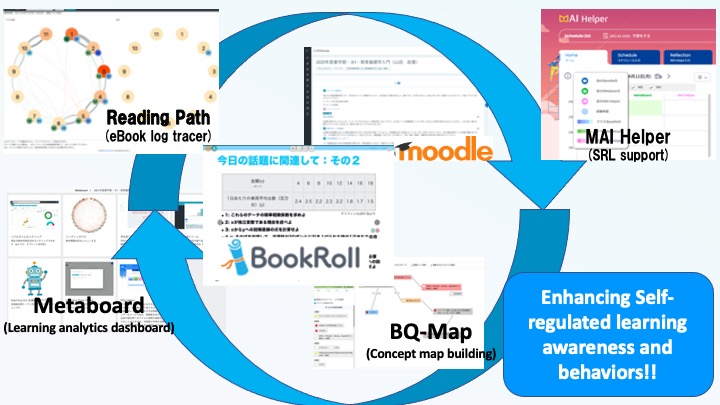
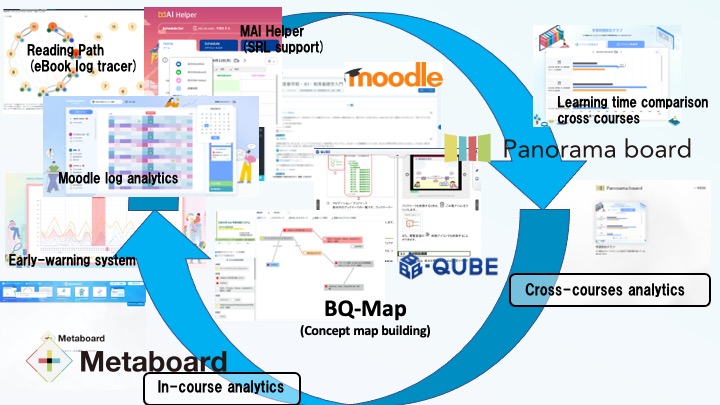
The goal of this project is to develop and evaluate learning support tools using Learning Analytics, with the aim of fostering active learners. Regarding learner agency, we have organized our approach around the keywords of Self-Regulated Learning and its constituent element, Metacognition, and have designed learning support tools using Learning Analytics based on these theories. We developed Metaboard as a Learning analytics dashboard (LAD), which serves as the foundation for our learning support tools, allowing learners to reflect on their own learning behaviors from perspectives they wish to examine. Researchers and developers can also upload their own tools to the developer version of Metaboard to verify their effectiveness. In addition, we have developed and evaluated Reading Paths, which allows students to compare their own learning behaviors on eBooks with those of the entire class, and MAI Helper, which supports students in planning their learning by comparing their access times with those of the entire class. We have found that learners who actively utilized Metaboard in their studies also showed increased activity in their daily learning behaviors, and that it contributed to statistically significant improvements in some academic performance metrics.
Development and Evaluation of Learning Dashboards to Support Decision-Making in Learning Behaviors 2021–2023
I believe that the decision of whether or not to engage in learning is ultimately up to the learner. From primary to secondary education, teachers intervene in learners' studies in various ways, but in the end, the decision to learn and the act of doing so are matters for the learner. However, I think it is a natural desire for teachers to want to support learners in making the decision to learn on their own and to promote Self-Regulated Learning. This research project focuses on the design, development, and evaluation of learning dashboards that activate metacognition, which is one of the elements that support learners' decision-making. This research is supported by the JSPS KAKENHI Grant-in-Aid for International Leading Research (B) and is a joint research project with Dr. Stephanie Teasley of the University of Michigan.
Definition of Educational Data Literacy and Construction of Its Development Model 2021–2024
In recent years, the vast amount of learning logs accumulated in learning support systems has been utilized for developments such as learning dashboards. This is an active research field, and it has become a major topic at the Learning Analytics and Knowledge (LAK) international conference, which specializes in Learning Analytics.
While visualizing the results of learning log analysis, such as through dashboards, and providing feedback to learners and instructors is beneficial, it is ultimately the learners, instructors, or other users who must decide what to do after viewing these visualized results. This research defines the ability to interpret visualized results, consider how to apply them to one's own learning, and take action as "Educational Data Literacy." The objective of this study is to organize the competency elements related to Educational Data Literacy and to construct a model for its development.
Research supported by JSPS KAKENHI Challenging Research (Pioneering) (Principal Investigator: Yamada)
MEXT Model Project for Promoting Educational Information Sharing "e-Teacher Project" 2003 – 2004
Since fiscal year 2003, the Ministry of Education, Culture, Sports, Science and Technology (MEXT) has implemented a model project (the "Model Project for Promoting the Sharing of Educational Information") aimed at expanding the network of teachers in the same subjects and encouraging teachers' voluntary improvement of their IT instructional skills. We built and operated a website to share lesson examples for disseminating the research results of the regional research groups designated for this model project to teachers nationwide. From 2005 onwards, the project management was transferred to Mitsubishi Research Institute, Inc., and it was successfully completed (Project Planning and Evaluation Committee Chair: Professor Kanji Akahori).
International Comparative Study on Information Morals
We collected and analyzed data from educators around the world regarding information technology and information ethics. This Report covers mobile phone usage, parental responsibility, and the attitudes and initiatives of teachers toward learners who lack information ethics (Principal Investigator: Professor Kanji Akahori, Tokyo Institute of Technology).
Research on Support Systems for Developing English Communication Skills Using Synchronous CMC 2003 – 2008
This research was conducted throughout my master's and doctoral programs. Computer-Mediated Communication (CMC) tools refer to communication mediated by computers, and among these, real-time communication tools such as text chat and video conferencing are called "synchronous CMC." This research examined the effects of synchronous CMC and learners' video and audio on foreign language communication learning, as well as the points to consider when designing language education systems. This research was supported by KAKENHI.
Nariki-ri English! 2006 – 2008
We are developing and evaluating English listening materials tailored to the context of learners' English usage. The system used to run these materials is the Willcom W-zero3. In fiscal year 2007, we converted the sales activities of Nippon Steel Corporation into English learning materials for their employees and verified their effectiveness.
In fiscal year 2008, we conducted an analysis and verification of the results. When comparing the target sales staff of "Narikiri English!" with non-sales staff, although there was no difference in the improvement of English proficiency, a follow-up survey two months later indicated that sales staff were able to use expressions learned in "Narikiri English!" during tasks such as handling phone calls. This suggests that the materials contributed to a subjective sense of efficacy regarding practical skill improvement. I was primarily responsible for the system design and development. This was a project of the Benesse Advanced Educational Technology Course at the Interfaculty Initiative in Information Studies, The University of Tokyo (Project Leader: Associate Professor Jun Nakahara, The University of Tokyo).
English for Career Advancement 2008
English for Career Advancement is a spin-off project of "Nariki-ri English!" To disseminate the research results cultivated through "Nariki-ri English!", we provided the content via Podcasting instead of the Willcom W-zero3. English for Career Advancement primarily targeted professionals working in the IT industry. We conducted interviews with IT professionals to select common scenarios encountered in business dealings with overseas companies, and developed the teaching materials using English vocabulary, expressions, and technical terminology frequently used on English-language IT company websites. This was a joint research project between the University of Tokyo and Benesse Corporation. I was involved in tasks such as selecting business scenarios and planning the storylines. The project was featured in numerous media outlets, including Nikkei Net, Nikkan Kogyo Shimbun, and ITmedia. It ranked #1 on iTunes Podcasting for 8 consecutive weeks! (The service has now been discontinued.)
Verification of the Effects of Social Presence and Cognitive Presence on Task-Based Language Learning 2008-2009
In distance education, it is argued that feeling the presence of other learners is effective for the affective aspects of learning, such as increasing learning motivation and improving learning satisfaction. Although there are many practical applications of distance education in foreign language education, research is often conducted without considering the background theories of learning sciences and psychology related to distance education. In this study, we focused on "presence" to verify how feeling the presence of others can be linked to actual learning in task-based foreign language education (individual research). The results of this study were published in Computers & Education. Research funded by KAKENHI.
Conomi+ 2008 – 2009
Conomi+ is an English learning system designed to allow users to study English "casually" outside of school, such as at home. Using collaborative filtering—a recommendation algorithm similar to those used by sites like Amazon.co.jp—the system delivers English news tailored to the learner's interests. By incorporating cognitive and social learning support features such as a dictionary, vocabulary registration, and comment input, it provides a mechanism that encourages continuous learning outside the classroom. In the second phase, we developed and evaluated a new collaborative filtering algorithm that "recommends content that is not a perfect match but is of some interest." Compared to conventional collaborative filtering, the results showed that learners explored a wider range of news genres and achieved higher learning outcomes. I was responsible for the overall system design, part of the evaluation, and project direction. This was a project of the Endowed Chair for Advanced Educational Technology at the Interfaculty Initiative in Information Studies, The University of Tokyo (Project Leader: Associate Professor Yuhei Yamauchi, The University of Tokyo). The results of this research were published in Educational Technology Research & Development.
Development of a Learning Analytics Platform Utilizing Educational Big Data 2016-2020
As ICT is being accepted and becoming widespread in educational settings, a major benefit of using ICT is the ability to record learners' learning activities, or logs. By utilizing these records, it becomes possible to derive characteristics such as where learners are struggling, how they are learning, and when they are learning, enabling optimized learning support for individual learners. Furthermore, beyond just learning support, feeding back the results of analyzing the learning records of students in a class to instructors is expected to lead to improvements in teaching. This field of research is called Learning Analytics and is spreading globally. This research aims to develop and evaluate a Learning Analytics platform that connects primary and secondary education, higher education, and adult education. I am involved as a co-investigator in this research project, for which Professor Hiroaki Ogata (Kyoto University) serves as the principal investigator (JSPS KAKENHI Grant-in-Aid for Scientific Research (S)). Reference: Kyushu University Learning Analytics Center http://la.kyushu-u.ac.jp/index.html
Learning Analytics Research in Multi-generational Co-creation 2017-2019
In Japan, the population aged 65 and over was 23% of the total population in 2010, and it is expected to approach 30% in 2020. As we truly enter a super-aging society, various forms of social life support will be required. It is desirable to foster active seniors and aim for social development that leverages the rich experience of the elderly. In this research, as one method for building a multi-generational co-creation society centered on the elderly, we aim to extend the Learning Analytics infrastructure to support multi-generational co-creation and social activities. This is being conducted as research at the Learning Analytics Center under a research project led by Prof. Konomi (Kyushu University) (JST Mirai Program).
Instructional Material Development Project for Academic Librarians Supporting Learning: “ILI-L” 2014-2017
This project is the successor to the ILI-L Librarian Training Program, which is also introduced in "Past Projects," and is being continued with research grant funding. Similar to the ILI-L Librarian Training Program, we will develop educational materials that contribute to the cultivation of knowledge and skills related to learning support, in accordance with the principles of Instructional Design and the learning sciences. We plan to expand the content and incorporate mechanisms that can be utilized in the daily work of university librarians. This project builds upon our joint research (now concluded) funded by KAKENHI with Prof. Watanabe (Kyushu University), Prof. Goda (Kumamoto University), and Prof. Masukawa (Shizuoka University).
Development and Evaluation of a Collaborative Online International Learning (COIL) Support System 2014-2017
In recent years, an increasing number of universities have been incorporating collaborative learning with faculty and students from overseas universities as part of their efforts to cultivate global human resources. This educational format, which involves collaborating with overseas universities to conduct collaborative learning in a foreign language, is known as COIL (Collaborative Online International Learning). As part of study abroad support, conducting COIL with faculty and students at the destination university in advance is expected to facilitate adaptation upon arrival. However, conducting COIL with overseas universities involves many challenges that require facilitation, including not only the design of the environment and content, but also issues such as time differences, cross-cultural understanding, and language proficiency. This research aims to examine the facilitation necessary when conducting collaborative learning with overseas universities, and to develop and evaluate a system that makes such facilitation easier. This is a joint research project funded by KAKENHI with Prof. Goda (Kumamoto University), Prof. Ishige (Otemae University), and Prof. Handa (Saitama Institute of Technology).
Development and Evaluation of a Game-Based Learning System for Library Utilization Education 2015-2016
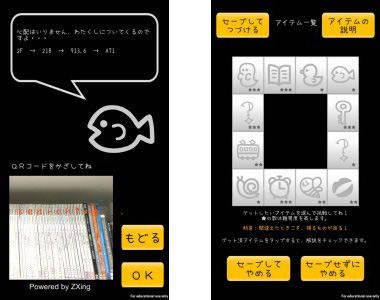
This research involves the development and evaluation of a game-based learning system designed as educational material for students who are unsure how to utilize the library. For the game design, we incorporated the ARCS model, a framework within Instructional Design, and conducted our development based on an analysis of seminars and materials previously used at university libraries. The system runs on smartphones, allowing students to clear the game while actually exploring our university library. This is a joint research project with Professor Kaneko (Kyushu University) and our university library staff (supported by a Grant-in-Aid for Challenging Exploratory Research and a grant from the Foundation for the Advancement of Science and Technology).
Development and Evaluation of Game-Based Learning Environments Outside the Classroom 2015-2016
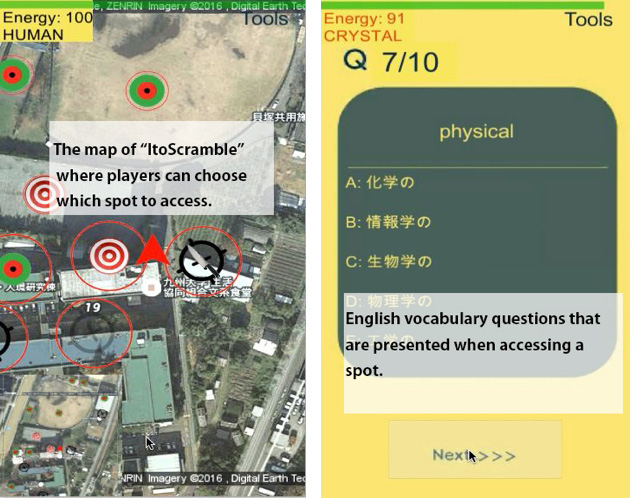
This research project was launched with the aim of developing and evaluating game-based learning environments to make out-of-class learning more effective. By utilizing location information and other data, we designed learning activities that can only be completed by visiting specific locations, thereby constructing an environment where students learn as if they were playing a game. The students were divided into two teams, and the game displayed English words related to a specific location, which the students then had to define. It is a territory-capture game where, once a certain accuracy rate is exceeded, the team can capture that "location" as a spot. Formative evaluation showed a significant trend toward effectiveness in vocabulary acquisition. This is a joint research project with Prof. Okada (Kyushu University) and Prof. Kaneko (Kyushu University). It was conducted with the support of a JSPS KAKENHI Grant-in-Aid for Challenging Research (Exploratory).
ILI Librarian Training Program 2012-2013
Currently, the role of libraries is undergoing significant changes amidst major trends such as the expansion of the university's role in society, the library as a place for learning, and the digitization of books. Naturally, the competencies required of library staff are changing in line with these times. However, due to factors such as the reduction in the number of library staff at universities, the current training of library staff is not being implemented effectively, even though its necessity is recognized. In this project, we will carry out initiatives to train library staff that meet contemporary needs. I am involved in the creation of training programs and the conversion of learning content into e-learning formats. Project grant by the Library Promotion Foundation. A collaborative project between Nagoya University Library, Shizuoka University Library, and Kanazawa University Library.
Development of a Mentoring Support System to Promote Self-Regulated Learning in e-Learning 2009 – 2012
I am conducting research on a mentoring support system that promotes Self-Regulated Learning for learners in e-learning environments. A major challenge in e-learning, where learners rarely attend lectures in person, has been and continues to be the difficulty of maintaining learning continuity. To address this, it is considered necessary to provide support for learners' affective aspects, such as through appropriate mentoring provided by mentors. However, for mentors, constantly monitoring the status of learners and responding as quickly as possible places a very high burden on their workload. Furthermore, it is problematic to foster learners who cannot study without a mentor. Based on these two issues, this research focuses on Self-Regulated Learning theory and aims to develop and evaluate a mentoring support system designed to support learners' Self-Regulated Learning attitudes and behaviors. This is a joint research project funded by KAKENHI with Prof. Miyagawa, Prof. Matsuda, Prof. Saito (Aoyama Gakuin University), Prof. Kato (The Open University of Japan), and Prof. Goda (Otemae University).
"IDO" Project: A Collaborative Learning Support System Focusing on the "Frog in the Well" Effect, 2009-2012
The "Big-Fish-Little-Pond Effect" (BFLPE) is an effect that utilizes academic self-concept. Academic self-concept refers to the self-knowledge and self-image that an individual holds regarding their own academic abilities. For example, when a student forms an academic self-concept in English, they often subjectively evaluate their own English proficiency by comparing themselves to the class average provided by the teacher or by hearing their peers' test scores; this is precisely when an academic self-concept is being formed. The effect on academic self-concept brought about by such social comparison is called the "Big-Fish-Little-Pond Effect." The "IDO" system is based on the Big-Fish-Little-Pond Effect and is a system that supports collaborative learning by automatically creating groups from test scores that allow students to form a positive academic self-concept. This is a joint research project funded by KAKENHI with Professor Yamauchi (The University of Tokyo), Professor Kitamura (Tokyo Keizai University), Professor Misono (Shimane University), and Professor Matsukawa (Osaka University).
Development and Evaluation of a Flipped Classroom Support System Incorporating the Knowledge-Constructive Jigsaw Method 2014-2016
The terms "flipped classroom" or "flipped learning" are spreading both in Japan and abroad. A "flipped classroom" refers to a teaching method where the input portion of learning—such as lectures and explanations of example problems that were previously conducted during class—is assigned as pre-class homework. In class, the time is then used for activities that promote deeper learning based on the content covered in that homework.
While the concept itself is not surprisingly novel, the emergence of ICT has made it possible to grasp the status of learners' pre-class study before the lesson begins. This allows for the modification of lesson plans based on that understanding, the provision of pre-recorded lecture videos to learners, and the utilization of open educational content such as OCW, YouTube EDU, and MOOCs, which distinguishes this approach from traditional methods.
In this research, we are developing and evaluating a system that incorporates the Jigsaw method starting from the pre-class assignment stage. This system provides support for creating expert groups and jigsaw groups, as well as for searching for learning materials and assigning them to learners. This is a joint research project funded by KAKENHI with Prof. Yasunami (Kumamoto University), Prof. Goda (Kumamoto University), Prof. Matsukawa (Osaka University), and Prof. Hata (Otemae University).
Development and Evaluation of a Mentoring Support System Based on Self-Regulated Learning Theory 2012-2015
This is a continuation of a KAKENHI-funded research project led by Professor Hiroyuki Miyagawa of Aoyama Gakuin University. In the mentoring support system based on self-regulated learning theory that we developed up until the last fiscal year, we were able to support mentors using key functions such as estimating a learner's level of self-regulated learning based on values calculated from questionnaires on self-regulated learning in online education to identify learners in need of support, and providing support that should be implemented during the planning phase of the self-regulated learning cycle based on mentoring guidelines. However, while we were able to reduce the workload of mentors (the learning supporters) to some extent, the essential goal of improving the learners' own self-regulated learning levels remained insufficient. In this project, which started in fiscal year 2012, we plan to develop and evaluate a system that also aims to enhance the learners' self-regulated learning levels. This is a joint research project funded by KAKENHI with Professor Miyagawa (Aoyama Gakuin University), Professor Kato (The Open University of Japan), Professor Goda (Kumamoto University), Professor Matsuda (Shimane University), and Professor Saito (Aoyama Gakuin University).
Development and Evaluation of “C4”: A Foreign Language Learning Support System for Facilitating Social and Cognitive Interaction 2011-2013
The purpose of this research is to develop and evaluate a support environment for foreign language learning outside of the classroom. In foreign language education, it is difficult to achieve learning goals through university classes alone, making out-of-class learning essential. However, in recent years, foreign language education and learning have increasingly required the construction of environments that provide learning opportunities outside the classroom—not only for motivation but also for the fundamental purpose of foreign language learning: "thinking about something using English." In this research, we developed and evaluated a collaborative foreign language learning support system called "C4 (Collaborative Communication for Class)" that incorporates support not only for social interaction among learners but also for building human relationships and deepening thoughts on given themes using English. It was developed as a Moodle module. This is a joint research project funded by KAKENHI with Prof. Yasunami (Kumamoto University), Prof. Goda (Kumamoto University), Prof. Hata (Otemae University), and Prof. Matsukawa (Osaka University). The results of this research project received the Best Paper Award at ICWL2014.
Learning Analytics Research in Multi-generational Co-creation 2017-2019
In Japan, it is estimated that the population over 65 years old will account for 23% of the total population in 2010 and close to 30% by 2020. With a truly super-aging society, a variety of social life supports will be required. We believe that it is desirable to develop active seniors and to utilize the rich experience of the elderly in order to achieve social development. This research aims to extend the learning analytics platform to support multi-generational co-creation and social activities as a way to build a multi-generational co-creation society centered on the elderly. This research project (JST Future Society Creation Project) is led by Dr. Kizane (Kyushu University) and conducted as the research of the Learning Analytics Center.
Development and Evaluation of a Multi-Country Cooperative Learning Support System (COIL) 2014-2017
In recent years, an increasing number of universities have begun to offer cooperative learning programs with faculty members and students from overseas universities to develop global human resources. COIL is an educational format that promotes cooperative learning in foreign languages in cooperation with overseas universities. As part of support for study abroad, COIL with faculty and students in advance can be expected to help students adjust to their study abroad environment. However, in order to conduct COIL with overseas universities, there are many things that must be facilitated, including not only the design of the environment and content, but also time difference issues, cross-cultural understanding, language skills, and so on. The purpose of this study is to examine the facilitation required when conducting cooperative learning with overseas universities, develop a system that helps such facilitation, and evaluate the system. Joint research with Dr. Goda (Kumamoto University), Dr. Ishige (Otemae University), and Dr. Handa (Saitama Institute of Technology), funded by a Grant-in-Aid for Scientific Research.
Project for the development of teaching materials for university librarians who want to support learning "ILI-L" 2014-2017
This project is the successor to the ILI-L Librarian Development Project, which is described in the “Past Projects” section, and is ongoing with a research grant. We will continue to develop instructional materials that contribute to the development of knowledge and skills related to learning support, in line with the findings of instructional design and learning science. We plan to increase the content and incorporate mechanisms that can be used in the work of university librarians. We are developing a joint research project (completed) with Dr. Watanabe (Kyushu University), Dr. Goda (Kumamoto University), and Dr. Maskawa (Shizuoka University), funded by a Grant-in-Aid for Scientific Research.
Development and Evaluation of a Game-Based Learning System for Learning to Use the Library 2015-2016
This study develops and evaluates a game-based learning system for students who do not know how to use the library. The ARCS model, a type of instructional design, was used as the design of the game, and the development was based on an analysis of seminars and teaching materials that have been held in university libraries in the past. The game is activated on a smartphone, and the user actually explores the University’s library while completing the game. A joint research project between Dr. Kaneko (Kyushu University) and members of the University Library (Grant-in-Aid for Challenging Budding Researchers, Grant-in-Aid for Public Interest from the Foundation for Fusion of Science and Technology).
Development and Evaluation of Game-Based Learning Environments Outside the Classroom 2015-2016
This research project started with the aim of developing and evaluating a game-type learning environment to make learning outside the classroom more effective. The game is divided into two teams, and the game displays English words related to a certain place, and students answer the meaning of the words. If the students exceed a certain percentage of correct answers, they are awarded a spot in that “place” in the game. Formative evaluation showed that there was an effect on word acquisition. Collaborative research with Dr. Okada (Kyushu University) and Dr. Kaneko (Kyushu University), funded by JSPS Grant-in-Aid for Challenging Exploratory Research (Budding Researchers).
Development and Evaluation of a Flipped Classroom Support System Incorporating the Knowledge Construction Jigsaw Method 2014-2016
The term “flipped classroom” or “flipped learning” is spreading both in Japan and abroad. The term “flipped classroom” refers to the practice of conducting classes that encourage deeper learning by building on the content of lectures, answers to example problems, and other aspects of learning input that have been conducted in class in the past as prior learning homework, and then building on this homework in the classroom. The concept is not so new as to be surprising, but with the advent of ICT, it has become possible to grasp the learners’ prior learning status before the class, to change the class design based on the grasped content, to shoot lecture videos in advance and provide them to the learners, and to provide the students with the lectures. The ability to utilize open education content such as OCW, YouTube.Edu, and MOOCS is a difference from the past. In this study, we will develop and evaluate a system that incorporates the jigsaw method from the stage of doing that pre-assignment, supports the creation of expert groups and jigsaw groups, and also supports the exploration of teaching materials and their assignment to learners. Joint research with Dr. Yasunami (Kumamoto University), Dr. Goda (Kumamoto University), Dr. Matsukawa (Osaka University), and Dr. Hata (Otemae University), funded by a Grant-in-Aid for Scientific Research.
ILI Librarian Development Project 2012-2013
Today, the role of libraries is changing dramatically by the spread of the view of universities as open to society, libraries as places for learning, and the digitization of books. In line with this era, the competencies required of library staff are naturally changing. However, due in part to reductions in the number of library staff at universities, the current training of library staff, while recognized as necessary, is not being implemented well. This project will train library staff to meet current needs. I will be involved in the project in terms of the creation of training programs and e-learning of learning content. Project grant from the Foundation for Library Promotion A collaborative project among Nagoya University Library, Shizuoka University Library, and Kanazawa University Library.
Development and Evaluation of Mentoring Support System Based on Self-Regulated Learning Theory 2012-2015
This is continuous research of a Grant-in-Aid for Scientific Research project led by Dr. Hiroyuki Miyagawa of Aoyama Gakuin University. The mentoring support system based on the self-regulated learning theory, which we have been working on until last year, is a system that estimates the degree of self-regulated learning of students based on the value calculated from a questionnaire that indicates the degree of self-regulated learning in online learning and support mentors with a function to estimate learners who need support and a function to provide them with a support based on the mentoring guideline in the planning stage of learning in the self-regulated learning cycle. However, although we were able to reduce the workload of the mentors, who are the learning supporters, to some extent, the key part of improving the learner’s self-regulated learning was still insufficient. In this project started in FY2012, we plan to develop and evaluate a system that aims to increase the learner’s self-regulated learning level as well. Collaborative research with Dr. Miyagawa (Aoyama Gakuin University), Dr. Kato (Open University of Japan), Dr. Goda (Kumamoto University), Dr. Matsuda (Shimane University), and Dr. Saito (Aoyama Gakuin University), funded by a Grant-in-Aid for Scientific Research.
Development and Evaluation of "C4″, a Foreign Language Learning Support System for Activating Social and Cognitive Interaction 2011-2013
The purpose of this research is to develop and evaluate a foreign language learning support environment outside of the classroom. In foreign language education, it is difficult to achieve mastery goals in university classes alone, so learning outside of class is important. Also, In recent years, there has been a growing need to create an environment that provides learning opportunities outside of the classroom in line with the original purpose of foreign language education, which is to motivate students to learn and to “think about something using English”. In this study, we developed and evaluated a cooperative foreign language learning support system “C4 (Sequad),” which incorporates not only social interaction among learners, but also support for building human relationships and deepening thinking about a given topic using English. The system has been developed and evaluated as a module of Moodle. Collaborative research with Dr. Yasunami (Kumamoto University), Dr. Goda (Kumamoto University), Dr. Hata (Otemae University), and Dr. Matsukawa (Osaka University), funded by a Grant-in-Aid for Scientific Research. The results of this research project received the Best Paper Award at ICWL2014.
IDO" Project, a cooperative learning support system focusing on the "frog-in-the-well" effect, 2009-2012
“frog in the well” effect is the effect of utilizing the academic self-concept. For example, a student’s academic self-concept in English may be based on his/her subjective evaluation of his/her own English ability by the average score given by the teacher and the test scores of his/her friends during the in-class tests. This is exactly when the academic self-concept is formed. Such an effect of academic self-concept brought about by social comparison is called the “frog in the well” effect.” The “IDO” system conforms to the “frog in the well” effect and supports cooperative learning by automatically creating groups that can form a positive academic self-concept of themselves based on their test scores. Joint research with Dr. Yamauchi (University of Tokyo), Dr. Kitamura (Tokyo Keizai University), Dr. Misono (Shimane University), and Dr. Matsukawa (Osaka University), funded by a Grant-in-Aid for Scientific Research.
Development of a Mentoring Support System to Facilitate Self-Regulated Learning in e-Learning 2009 - 2012
We are conducting research on a mentoring support system that promotes self-regulated learning in e-learning. A major challenge in e-learning has been the lack of continuity in learning, which is based on the assumption that there are almost no face-to-face lectures. For this reason, it is said that it is necessary to provide emotional and other support to learners, such as appropriate mentoring by a mentor. However, the workload for the mentor is very high because he or she is required to keep track of the learner’s situation and respond as quickly as possible. It is also problematic to train learners who cannot learn without a mentor. Based on the above two problems, this study focuses on the self-regulated learning theory, and develops and evaluates a mentoring support system to support learners’ self-regulated learning attitude and behavior. Joint research with Dr. Miyagawa, Dr. Matsuda, Dr. Saito (Aoyama Gakuin University), Dr. Kato (Open University of Japan), and Dr. Goda (Otemae University), funded by a Grant-in-Aid for Scientific Research.
Conomi+ 2008 - 2009
Conomi+ is an English learning system designed to make it easy for students to study English at home or outside of school. The system uses collaborative filtering, a recommendation algorithm used by Amazon.co.jp and others, to deliver English news that matches the learner’s interests, and provides cognitive and social learning support such as dictionary functions, word registration, and comment input, so that students can continue learning even outside of school. The system is designed to support students to continue their learning outside of school. In the second phase, we developed and evaluated a new collaborative filtering algorithm that “recommends items that are not a perfect fit but are of some interest. Compared to conventional collaborative filtering, the results showed that it produced a wider range of news genres to read and better learning outcomes. I was responsible for the overall design of the system, part of the evaluation, and the direction of the project. The project was conducted by the Benesse Chair of Advanced Educational Technology in the Interfaculty Initiative in Information Studies, Graduate School of Interdisciplinary Information Studies, the University of Tokyo (supervised by Dr. Yuhei Yamauchi, Associate Professor at the University of Tokyo). The results of this research have been accepted for publication in Educational Technology Research & Development.
Examining the Effects of Social Presence and Cognitive Presence on Task-Based Foreign Language Learning 2008- 2009
In remote learning, it has been claimed that feeling the presence of other learners around you can be effective in the affective aspects of learning, such as increasing motivation to learn and satisfaction with learning. Although there are many practices of remote learning in foreign language education, most of those studies have been conducted without considering the background theories of learning science and psychology related to remote education. In this study, we focused on “presence” in task-based foreign language education in order to examine the method of linking a sense of the other’s presence to actual learning (individual research). The results of this research were accepted for publication in Computers & Education. Research funded by Grant-in-Aid for Scientific Research
English de Career Development 2008
English de Career Up is a spin-out project of “NARIKIRI English! In order to disseminate the research results of “NARIKIRI ENGLISH!”, we have made it available via podcasting instead of Willcom’s W-zero3. English de Career Up mainly targets those who work in the IT industry. The materials were selected through interviews with people working in IT companies and were developed using English vocabulary and expressions frequently used on English web pages of IT companies, as well as specialized vocabulary and expressions. This was a joint research project between the University of Tokyo and Benesse Corporation. I was engaged in selecting the work and planning the stories. Featured in Nikkei Net, Nikkan Kogyo Shimbun, ITMedia, and many other media. iTunes Podcasting #1 for 8 consecutive weeks! (The service has now been terminated.)
Narikiri English! 2006 - 2008
We develop and evaluate English listening materials tailored to the context of learners’ English use. The system that runs the teaching materials uses Willcom’s W-zero3. In FY2007, we developed and evaluated the effectiveness of the program for Nippon Steel Corporation employees. In fiscal 2008, we conducted an analysis and verification of the effectiveness of the program. The results of the comparison between the sales and non-sales representatives targeted by “NARIKIRI ENGLISH!” showed no difference in growth in English ability, but a delayed survey conducted two months later showed that the sales representatives were able to use expressions from “NARIKIRI ENGLISH! The results showed that the program contributed to a subjective sense of efficacy in terms of improvement in practical skills. I was mainly responsible for the design and development of the system. The project was conducted by the Benesse Department of Advanced Educational Technology, Interfaculty Initiative in Information Studies, Graduate School of Interdisciplinary Information Studies, the University of Tokyo (supervised by Associate Professor Jun Nakahara of the University of Tokyo).
Research on English Communication Skills Development Support System Using Synchronous CMC 2003 - 2008
This research was conducted throughout my master’s and doctoral programs. Computer-mediated communication (CMC) tools are real-time communication tools such as text chat and video conferencing, which are called “synchronous CMC. This research examines the effects of synchronous CMC and learners’ video and audio on communicative learning in a foreign language, and how a language education system should be designed. Research funded by Grant-in-Aid for Scientific Research
International Comparative Study on Information Morale
Data on information technology and information morals was collected from educators around the world and analyzed. The study reports on the use of cell phones, parental responsibility, and teachers’ attitudes and efforts toward learners with poor information morals (Principal investigator: Prof. Kanji Akahori, Tokyo Institute of Technology).
Ministry of Education, Culture, Sports, Science and Technology, Model Project for Promoting Sharing of Educational Information "e-Teacher Project" 2003 - 2004
The Ministry of Education, Culture, Sports, Science and Technology (MEXT) has been implementing a model project (“Model Project for Promoting Sharing of Educational Information”) since FY2003 with the aim of expanding the circle of teachers of the same subject and encouraging teachers to voluntarily improve their IT teaching skills. We had built and operated a website for sharing class case studies to disseminate the research results of research groups in each region designated for this model project to teachers nationwide. After 2005, the project management was transferred to Mitsubishi Research Institute, Inc. and was successfully completed (Project Planning and Evaluation Committee Chairman: Professor Kanji Akahori).
MARK-LAB.NET@KYUSHU-U
Yamada Laboratory, Kyushu University
Yamada Laboratory is looking for prospective master's and doctoral students. If you want to contribute to the development of education in Japan and around the world, join us!

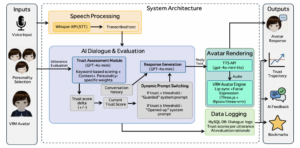 In this research, we have implemented a VR-based support system for training school nurses, who work to improve the physical and mental health of students. Specifically, we have modeled the characteristics of students whose mental state is not ideal, based on the opinions and records of experts with extensive experience as school nurses, and have integrated this into a generative AI. Students in school nurse training programs use this system to convert their spoken input into text, which is then sent to the generative AI; the AI's response is then converted into speech via TTS and delivered by an avatar. In professional development, where creating authentic situations is crucial, this system reproduces such scenarios to facilitate effective learning.
 In Learning Analytics research, dashboard research has become a major field, but it is not enough to simply use various algorithms to create dashboards, evaluate them, and improve practice. Dashboards exist only because there are platforms or content delivery infrastructures where original learning activities take place, such as Learning Management Systems, and they merely visualize the activities within those underlying systems. When you think about it carefully, there are many aspects that cannot be addressed without considering the design of the original platforms, such as Learning Management Systems or content delivery infrastructures. Often, as Learning Analytics progresses and key learning behaviors become visible, it becomes necessary to rethink the platforms themselves.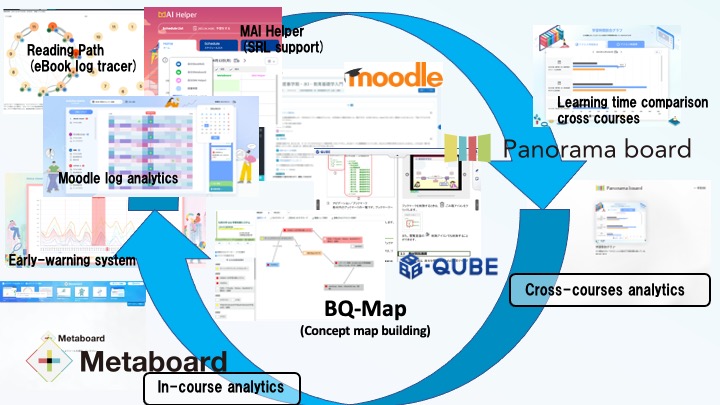
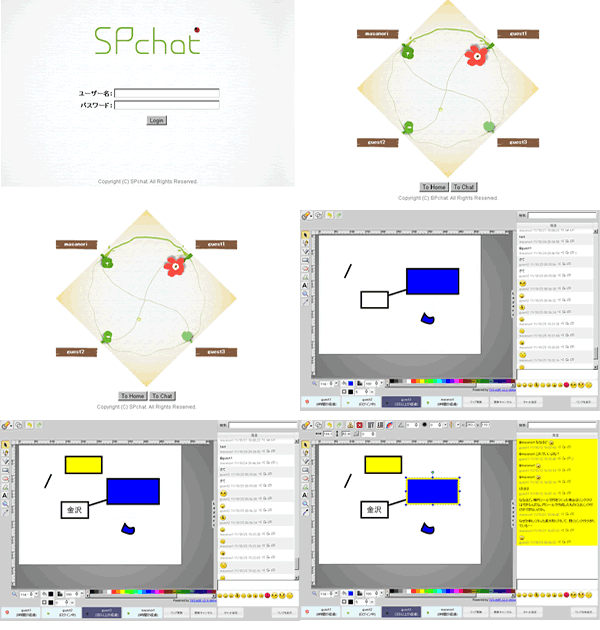
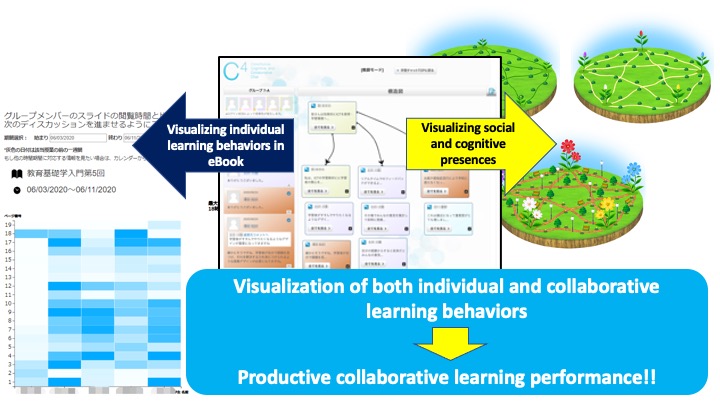 In short, social presence refers to "the sense of having another person present, or the ability to make others feel that presence," even in Computer-Mediated Communication (CMC) where the other party is not visible. In face-to-face interactions, humans communicate by weaving in their emotions through facial expressions and tone of voice; however, it was traditionally said that this was difficult in situations where the other party is invisible, such as in text-based CMC. However, since the early 1990s, this has been actively researched in the field of social psychology, and research findings have emerged showing that social behaviors, such as the formation of human relationships, occur even in CMC through emotional communication. In the late 1990s, research also appeared suggesting that social presence is strongly related to the content of remarks, and in e-learning, the view that the strength of social presence depends on the content of remarks has become more prevalent. It is said that social presence affects the formation of good groups in learning, especially in group learning such as collaborative learning, and also influences cognitive activities related to learning. In C4α, we extend the "C4" system developed in past projects to extract only those elements related to social presence and cognitive presence from the content of remarks, thereby visualizing the situation within the group. Furthermore, as learning support, we aim to support active project-based learning by providing a system linked with a concept map creation tool, a chat tool that supports remarks related to social presence, a tool to grasp the login status of others, and a project management tool for managing tasks within the group. The system developed in this project is also being developed as a Moodle plugin. This is a joint research project funded by KAKENHI (Grant-in-Aid for Scientific Research (B)) led by Professor Yamada.
 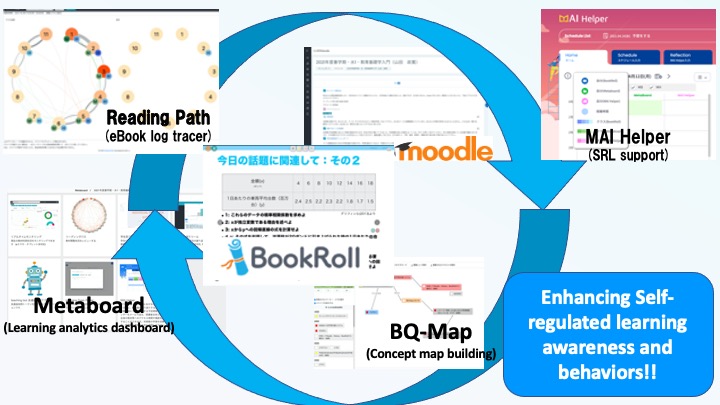 The goal of this project is to develop and evaluate learning support tools using Learning Analytics, with the aim of fostering active learners. Regarding learner agency, we have organized our approach around the keywords of Self-Regulated Learning and its constituent element, Metacognition, and have designed learning support tools using Learning Analytics based on these theories. We developed Metaboard as a Learning analytics dashboard (LAD), which serves as the foundation for our learning support tools, allowing learners to reflect on their own learning behaviors from perspectives they wish to examine. Researchers and developers can also upload their own tools to the developer version of Metaboard to verify their effectiveness. In addition, we have developed and evaluated Reading Paths, which allows students to compare their own learning behaviors on eBooks with those of the entire class, and MAI Helper, which supports students in planning their learning by comparing their access times with those of the entire class. We have found that learners who actively utilized Metaboard in their studies also showed increased activity in their daily learning behaviors, and that it contributed to statistically significant improvements in some academic performance metrics.
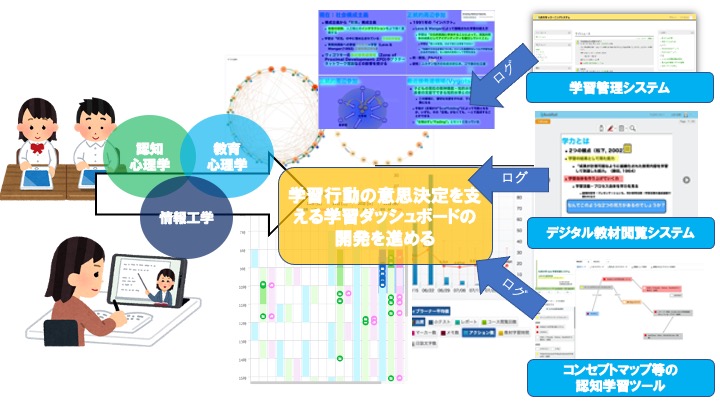 I believe that the decision of whether or not to engage in learning is ultimately up to the learner. From primary to secondary education, teachers intervene in learners' studies in various ways, but in the end, the decision to learn and the act of doing so are matters for the learner. However, I think it is a natural desire for teachers to want to support learners in making the decision to learn on their own and to promote Self-Regulated Learning. This research project focuses on the design, development, and evaluation of learning dashboards that activate metacognition, which is one of the elements that support learners' decision-making. This research is supported by the JSPS KAKENHI Grant-in-Aid for International Leading Research (B) and is a joint research project with
  We are developing and evaluating English listening materials tailored to the context of learners' English usage. The system used to run these materials is the Willcom W-zero3. In fiscal year 2007, we converted the sales activities of Nippon Steel Corporation into English learning materials for their employees and verified their effectiveness.
 English for Career Advancement is a spin-off project of "Nariki-ri English!" To disseminate the research results cultivated through "Nariki-ri English!", we provided the content via Podcasting instead of the Willcom W-zero3. English for Career Advancement primarily targeted professionals working in the IT industry. We conducted interviews with IT professionals to select common scenarios encountered in business dealings with overseas companies, and developed the teaching materials using English vocabulary, expressions, and technical terminology frequently used on English-language IT company websites. This was a joint research project between the University of Tokyo and Benesse Corporation. I was involved in tasks such as selecting business scenarios and planning the storylines. The project was featured in numerous media outlets, including Nikkei Net, Nikkan Kogyo Shimbun, and ITmedia. It ranked #1 on iTunes Podcasting for 8 consecutive weeks! (The service has now been discontinued.)
  Conomi+ is an English learning system designed to allow users to study English "casually" outside of school, such as at home. Using collaborative filtering—a recommendation algorithm similar to those used by sites like Amazon.co.jp—the system delivers English news tailored to the learner's interests. By incorporating cognitive and social learning support features such as a dictionary, vocabulary registration, and comment input, it provides a mechanism that encourages continuous learning outside the classroom. In the second phase, we developed and evaluated a new collaborative filtering algorithm that "recommends content that is not a perfect match but is of some interest." Compared to conventional collaborative filtering, the results showed that learners explored a wider range of news genres and achieved higher learning outcomes. I was responsible for the overall system design, part of the evaluation, and project direction. This was a project of the Endowed Chair for Advanced Educational Technology at the Interfaculty Initiative in Information Studies, The University of Tokyo (Project Leader: Associate Professor Yuhei Yamauchi, The University of Tokyo). The results of this research were published in Educational Technology Research & Development.
  This project is the successor to the ILI-L Librarian Training Program, which is also introduced in "Past Projects," and is being continued with research grant funding. Similar to the ILI-L Librarian Training Program, we will develop educational materials that contribute to the cultivation of knowledge and skills related to learning support, in accordance with the principles of Instructional Design and the learning sciences. We plan to expand the content and incorporate mechanisms that can be utilized in the daily work of university librarians. This project builds upon our joint research (now concluded) funded by KAKENHI with Prof. Watanabe (Kyushu University), Prof. Goda (Kumamoto University), and Prof. Masukawa (Shizuoka University).
 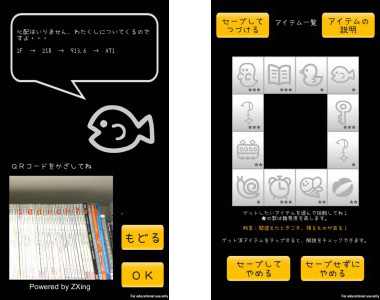 This research involves the development and evaluation of a game-based learning system designed as educational material for students who are unsure how to utilize the library. For the game design, we incorporated the ARCS model, a framework within Instructional Design, and conducted our development based on an analysis of seminars and materials previously used at university libraries. The system runs on smartphones, allowing students to clear the game while actually exploring our university library. This is a joint research project with Professor Kaneko (Kyushu University) and our university library staff (supported by a Grant-in-Aid for Challenging Exploratory Research and a grant from the Foundation for the Advancement of Science and Technology).
 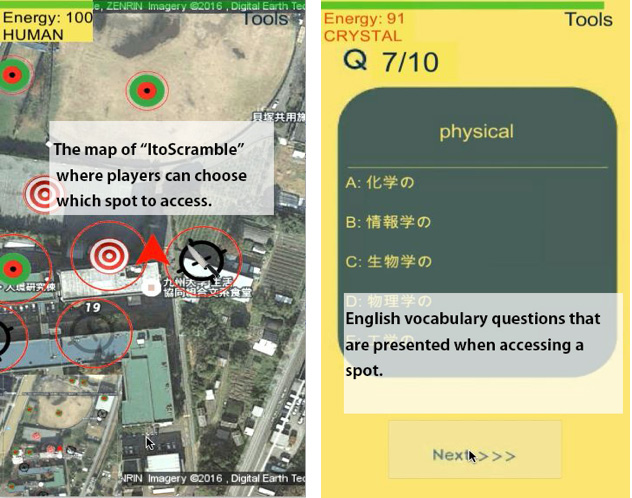 This research project was launched with the aim of developing and evaluating game-based learning environments to make out-of-class learning more effective. By utilizing location information and other data, we designed learning activities that can only be completed by visiting specific locations, thereby constructing an environment where students learn as if they were playing a game. The students were divided into two teams, and the game displayed English words related to a specific location, which the students then had to define. It is a territory-capture game where, once a certain accuracy rate is exceeded, the team can capture that "location" as a spot. Formative evaluation showed a significant trend toward effectiveness in vocabulary acquisition. This is a joint research project with Prof. Okada (Kyushu University) and Prof. Kaneko (Kyushu University). It was conducted with the support of a JSPS KAKENHI Grant-in-Aid for Challenging Research (Exploratory).
  The "Big-Fish-Little-Pond Effect" (BFLPE) is an effect that utilizes academic self-concept. Academic self-concept refers to the self-knowledge and self-image that an individual holds regarding their own academic abilities. For example, when a student forms an academic self-concept in English, they often subjectively evaluate their own English proficiency by comparing themselves to the class average provided by the teacher or by hearing their peers' test scores; this is precisely when an academic self-concept is being formed. The effect on academic self-concept brought about by such social comparison is called the "Big-Fish-Little-Pond Effect." The "IDO" system is based on the Big-Fish-Little-Pond Effect and is a system that supports collaborative learning by automatically creating groups from test scores that allow students to form a positive academic self-concept. This is a joint research project funded by KAKENHI with Professor Yamauchi (The University of Tokyo), Professor Kitamura (Tokyo Keizai University), Professor Misono (Shimane University), and Professor Matsukawa (Osaka University).
 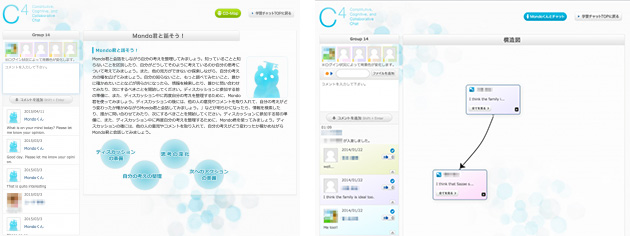 The purpose of this research is to develop and evaluate a support environment for foreign language learning outside of the classroom. In foreign language education, it is difficult to achieve learning goals through university classes alone, making out-of-class learning essential. However, in recent years, foreign language education and learning have increasingly required the construction of environments that provide learning opportunities outside the classroom—not only for motivation but also for the fundamental purpose of foreign language learning: "thinking about something using English." In this research, we developed and evaluated a collaborative foreign language learning support system called "C4 (Collaborative Communication for Class)" that incorporates support not only for social interaction among learners but also for building human relationships and deepening thoughts on given themes using English. It was developed as a Moodle module. This is a joint research project funded by KAKENHI with Prof. Yasunami (Kumamoto University), Prof. Goda (Kumamoto University), Prof. Hata (Otemae University), and Prof. Matsukawa (Osaka University). The results of this research project received the Best Paper Award at ICWL2014.