


Hello everyone. This is Kaku, an academic research fellow.
I would like to introduce a paper from our recent English seminar.
As I have mentioned in previous posts, my research focuses on improving Japanese language education, with a particular interest in the CLIL teaching approach. Therefore, for this English seminar, I read and would like to introduce a paper on training teachers to implement CLIL.
Paper Title: The effect of telecollaboration in the development of the Learning to Learn competence in CLIL teacher training
Journal: Interactive Learning Environments, 29(6), 973-986.
Authors: Garcia-Esteban, S., Villarreal, I., & Bueno-Alastuey, M. C.
Year of Publication: 2021
First, I will briefly introduce the content of this paper.
Many researchers have advocated for the development of teachers’ Learning to Learn (LtL) competence, but it has been suggested that these competencies are difficult to measure, making it challenging to analyze the impact of interventions on them. Furthermore, it has been pointed out that LtL does not necessarily improve even after completing higher education. Therefore, it is necessary to propose new approaches to foster LtL competence. As society develops and the importance of lifelong learning is recognized, acquiring LtL competence becomes increasingly important. The paper argues that in order to provide better instruction to students in the future, teachers themselves must first acquire this competence. This paper focuses on the effect of telecollaboration tools on the development of LtL competence in teacher education within the context of CLIL teacher training. In this paper, LtL competence is defined as the ability to improve the quality of one’s life and work as a result of self-directed, self-regulated, and intentional learning, with an emphasis on the ability to control one’s own thinking and learning processes, which is referred to as metacognitive ability. The questionnaire used for measurement in this paper was developed based on the definition of LtL by Fredriksson (2013).
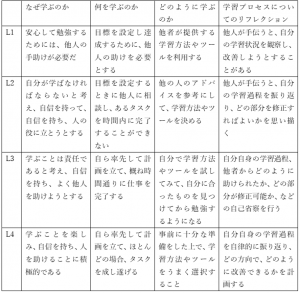
The participants in the study were teacher trainees from two universities in Spain, divided into a control group (53 students) and an experimental group (47 students). Students in both groups took a CLIL course in Educational Technology, and students in the experimental group used telecollaboration tools to complete the same learning tasks as the control group. Specifically, in the control group, teachers and students held face-to-face classes, but some tasks required online work in small groups outside the classroom. In the experimental group, students participated in a telecollaboration project consisting of two remote collaborations and a series of face-to-face tasks using the same technology as the control group. The impact of telecollaboration tools in the Educational Technology CLIL course on the development of LtL was evaluated by comparing pre- and post-questionnaires. The questionnaire was created based on the competency measurement method of Fredriksson (2013) and was conducted by dividing it into four areas: “Why to learn,” “What to learn,” “How to learn,” and “Reflection on the learning process,” each with four levels (L1 to L4). The levels of LtL are organized by the European Commission (2012) as follows.
Description of the 4 levels in 4 areas (European Commission, 2012)
As a result, moderate improvements were seen in all items at both universities, with the control group reaching +12.6% in level 2 of “How to learn.” Although there was a 5% decrease in the “What to learn” item after the course, the experimental group slightly outperformed the control group in all other items. Based on these results, the authors pointed out that the experience of learning with telecollaboration tools has a stronger impact than the course content related to ICT. They argue that this is due to experiential learning enhancing metacognition, and it has become clear that telecollaboration tools contribute to the development of learners’ LtL.
Finally, regarding my own impressions, although the content was not directly related to CLIL lesson design, as mentioned at the beginning of this paper, I believe that while it is difficult to measure and evaluate abstract competencies like LtL, it is necessary. In this paper, by setting up experimental and control groups in an actual course implementation and analyzing the impact of telecollaboration tools on LtL, I thought it provided hints for future research. However, since only questionnaire data was collected this time, it might have been better to have more detailed data to explain the results of the survey. It is certainly true that evaluation is difficult, but I was a little curious about whether it is sufficient to rely on the conventional method of using questionnaires. For example, analysis of conversations during collaboration with different groups or classroom observations could be used. I would like to apply the insights gained from this paper regarding the aspect of evaluating more abstract competencies to my own future research.