


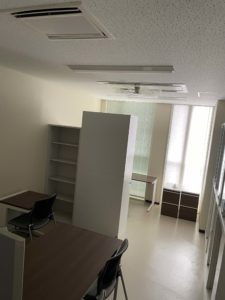
 It’s all clean now… The move is finished, and this is how it looks. I’m starting to realize that I am really leaving this place. I feel a mix of excitement to do my best on a new stage and a sense of sadness.
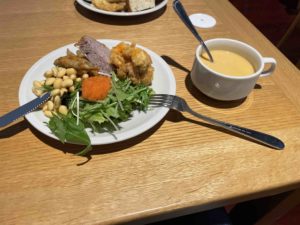 After finishing the move, to say “good job” and “thank you,” I had lunch with the students and our technical staff member, Mr. Akutagawa, at Itori-ito.
———
I never imagined a day like this would come. That the day I would leave the Faculty of Arts and Science would actually arrive. Somewhere in the back of my mind, I thought I would be working here until the very end. I have been here since January 2013, and I have served under three generations of leadership: Professor Maruno, Professor Taniguchi (Setsu), and the current Professor Harada. There are few faculty members left in the Faculty of Arts and Science who have served across three generations. However, this is also a good cycle where new energy enters and the organization evolves. Since Professor Kimura (Taku) moved to the Graduate School of Human-Environment Studies, I have been the most senior faculty member hired as a regular staff member. I have been with the Faculty of Arts and Science for 10 years and 3 months.
I remember so many things. There were many mentally challenging tasks, but thanks to the encouragement and support of many professors, including Professor Taniguchi (Setsu), Professor Nose, Professor Furuya, and Professor Harada, I managed to get through them well. I believe I have been able to pass on what I have been doing to my successors. I am also very grateful to have been granted a sabbatical.
I was surprised when Professor Hiroaki Ogata (now at Kyoto University) came from Tokushima University. I remember him knocking on my door with a smile, and when I said, “What! Did you really come here?” he laughed and replied, “I did.” I remember meeting him frequently at academic conferences and international symposiums since I was a master’s student and having many opportunities to talk with him, but I couldn’t believe he would come to Kyushu University, let alone the Faculty of Arts and Science. Launching the first Learning Analytics center in Japan, formulating and adopting the master plan, and working on IMS Glocal relations are all great memories of research we did together. My current position and research were significantly influenced by Professor Ogata’s arrival here. I am very grateful to him. It was truly here that the “Yamada who does Learning Analytics research” was formed. Even now, we meet frequently to talk about Learning Analytics research, challenges, and various other topics.
Designing the prototype of the course evaluation survey system together with the professors on the course evaluation survey team was also a valuable experience. Developing it as a Moodle plugin, creating a format that allows for downloading reports and making comparisons, and selecting survey questions tailored to specific courses—these were all very fulfilling experiences. Today, this system is deployed not only in the Faculty of Arts and Science but across the entire university.
I also taught various courses. Active learning was a very hot topic at the time, and Kyushu University, following the University of Tokyo, was one of the first national universities to move forward with it. There is a course called “Collaborative Learning” where three professors from different fields work together to approach a single theme from various perspectives, and I was involved in it from the trial stage. For the trial course, I worked with Professor Furuya and Professor Kaburagi, who is now the Dean of the School of Interdisciplinary Science and Innovation. It was a great opportunity to apply my knowledge of Educational Technology. I learned many things, such as how things don’t always go as well as the theory suggests and that you have to adapt according to the situation. It was also a great experience to challenge myself with various course designs using ICT, such as combining the Jigsaw method with flipped classrooms, aiming to improve the quality of liberal arts education. Many of these courses required a lot of preparation, but I enjoyed them, and I believe I have been able to improve my teaching since I started utilizing Learning Analytics (this is just my personal feeling). It also led to major research. I was able to feel the interplay between theory and practice.
I really remember so many things. Thank you very much for everything.