




At the beginning of August, I gave a keynote speech at a Faculty Development (FD) seminar on active learning at Nagasaki University. It was a wonderful seminar where the President and Vice President participated from start to finish. I used to organize FD seminars in Kanazawa, but during my time there, the President and Vice President of my own university never participated beyond giving opening remarks. It was clear that the President of Nagasaki University is strongly committed to promoting FD. It was truly impressive.
Regarding the content of my lecture, I won’t go into detail here, but I spoke about how active learning is often perceived as project-based learning, but in reality, it encompasses various approaches. I also discussed the importance of considering ways to elicit learner proactivity during course design, the use of tools (not just furniture, but also digital and virtual tools), their theoretical background and significance, and examples from both Japan and abroad. Finally, I talked about the challenges involved.
 Before the seminar, Professor Hiroki Yamaji of Nagasaki University gave me a tour of the campus. The building used for liberal arts education has eight classrooms that support collaborative active learning. I believe this is still rare among national universities. When people hear “active learning classroom,” they often have an image of it being “expensive.” Certainly, if you can properly organize the active learning concept and learning goals of your university and build a new classroom building that fits that concept, that would be an ideal model. However, in reality, there isn’t that much money available. Renovating existing classrooms is more realistic. When I was at Kanazawa, I wanted to inexpensively convert existing classrooms into active learning classrooms, so I applied for budgets, planned, and held FD sessions, but I couldn’t make it happen. When I tried to secure a budget, the feedback from the upper management who reviewed the proposals made me realize that the foundation for establishing active learning was not in place, making it difficult. I realized it’s not easily done (partly because I am not good at, and dislike, political maneuvering). However, Nagasaki University has realized exactly what I wanted to do. There is no need to be overly particular about the design of the furniture. It is desirable to have desks for one person that are flexible in their combinations, capable of supporting various learning styles, and allow for the redesign of the space as needed, since we don’t know what learning styles will be required in the future. A report by JISC in the UK also mentioned that classroom spaces that act as “experimental grounds for testing teaching styles” are desirable, and I completely agree.
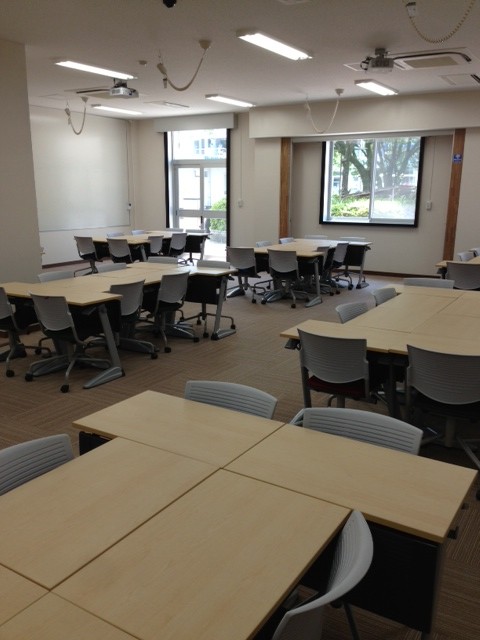 Some of the active learning classrooms had carpeted floors and were no-shoes zones. This was to enable dance and performance-based classes. I was told that the administrative staff is also working to ensure the usage of these spaces becomes established, such as by assigning active learning classrooms to liberal arts subjects.
Kyushu University will also start its new fundamental education program next year, which will primarily incorporate collaborative learning. As this happens, I think it will become difficult to conduct classes in existing classrooms. Trial classes are being held this year in preparation for next year, but the students seemed to have trouble moving around, and group work seemed difficult to facilitate. Even if we include activities where the whole group presents, I think we need to support them so they can do it better in terms of physical space. I hope these classrooms increase at Kyushu University as well.
 Before the classroom tour prior to the seminar, I actually visited the library. Two years ago, when the Japan Society for Educational Technology conference was held in Nagasaki, it was still under construction and I couldn’t see it, so this was a good chance. It had just started operating. The first floor is a commons area. In the commons area, there was a computer area, an area displaying textbooks used in university-wide education, and an exhibition of items related to the Meiji era held by Nagasaki University. Although it was during the break, there were students there, and they were actively learning. On the second floor, tables and chairs were lined up along the windows, supporting a style of individual study.
 This is a study area in the Open University of Japan center connected to the library. Collaborative learning is also possible here. I wonder if it’s possible to do something like a Flipped Classroom using the Open University’s teaching materials and broadcasts. Since it’s conveniently located right next to the Open University center.
 There was also an introduction to books recommended by the President. This is also a great activity because it shows the President’s stance on education.
It has only just started, and they said they will be considering and advancing learning support measures from here on. I believe it takes about two years for a culture to take root where the cycle of creating proposals for learning support in the learning commons, executing them, and observing the effects can be maintained. I am looking forward to seeing how things develop now that multiple active learning classrooms have been built in the liberal arts education building. It was a pleasure to see such good work.