


While my primary affiliation is with the Faculty of Arts and Science, I also hold a concurrent position as an Associate Professor at the Faculty of Human-Environment Studies, which allows me to teach courses in the Faculty of Education and the Graduate School of Human-Environment Studies. I am now able to provide research supervision to master’s students enrolling in October 2013 and April 2014. Please refer to the entrance examination information here. Below, I would like to outline the research themes I am working on and the type of students I am looking for.
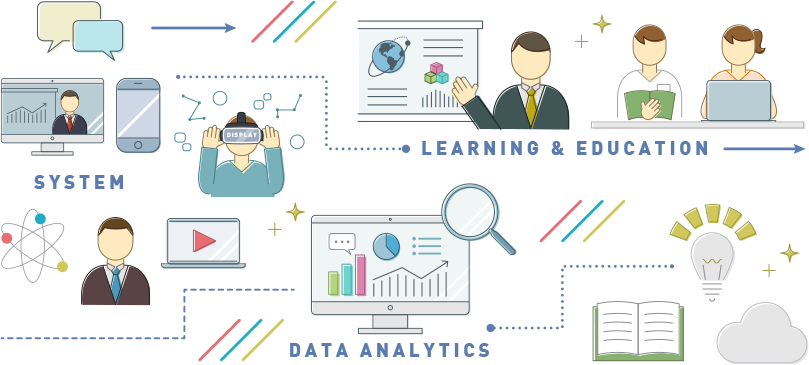
As mentioned in the title, my research theme is Educational Technology. Specifically, I focus on learning environment design, particularly research on collaborative learning environment design using Information and Communication Technology (ICT) based on a social constructivist view of learning. My work ranges from themes on how to introduce ICT into educational settings and learning environments to facilitate collaborative learning, to the development and evaluation of systems to support collaborative learning, their dissemination, and more recently, the construction of learning support environments in learning commons currently being built in university libraries. I also conduct research and practice regarding the design of physical classroom and learning environments, as well as the learning support and staff development that take place within them. My strength lies in “creation-based” research, which involves design, development, and evaluation. For specific research content and projects, please refer to my profile and projects pages.
As for the type of students I am looking for…
1: Students who genuinely want to conduct research
Graduate school is not a place to acquire skills, but a place to conduct research. Furthermore, research on education and learning is being conducted extensively not only domestically but also internationally, and understanding overseas research findings, such as those in international journals, is essential in this field. I know many people are not confident in English, but even if you are not good at it now, the willingness to overcome it is what matters. The option of “I’m not good at it, so I won’t read it or do it” is not possible in this field. The cycle of researching what you don’t understand, becoming able to understand it, critiquing it, and applying it to your own research is required in master’s programs, doctoral programs, and in society at large.
2: Active students
Graduate school is a place where you won’t get any opportunities if you just wait around (this may be true for undergraduate studies as well). Naturally, this is the same in companies and other parts of society. Through challenges such as presenting at domestic and international academic conferences, I hope you will increase your circle of peers, including researchers and students from both inside and outside Japan, which relates to my fourth point. Also, you cannot conduct research with only the knowledge gained in class. Please study and acquire the knowledge and skills related to your research on your own. You cannot complete graduate school with the mindset that everything will be “taught to you.” This is true not only at Kyushu University but at other universities as well.
3: Energetic students
It is not just physical stamina that is required, but also enthusiasm and sincerity. If you have enthusiasm and sincerity, things can be conveyed. This is the same in research, companies, and society. However, passion alone is not enough. It is meaningless to spin your wheels with just feelings and no scientific basis. Please be careful about that.
4: Students who enjoy collaboration
Helping each other with everyone’s research and the projects conducted in the laboratory to make them successful, and through that, growing yourself as well.
Regarding working students, the desire to enter graduate school and conduct research while working is wonderful. However, unless it is a work order, that choice is ultimately your own, and you should be prepared for the fact that it will often be physically and mentally demanding. There is no such thing as lowering the quality of research because you are a working student. The quality of research required is no different for regular students or working students. Engaging with domestic and international, especially overseas, research literature and conducting original research is completely independent of whether you are a working student or a student who has come straight from an undergraduate program. I welcome working students who are prepared to face the difficulty of making time and managing their research, and I will provide proper research supervision.
It is my wish that students belonging to my laboratory, regardless of the career path they choose, will grow to be active and vibrant, and able to demonstrate their potential as future experts. To that end, I want you to search for various domestic and international resources on your own, actively find learning opportunities, and grow. This is true for master’s students, and even if you go to companies, government offices, or local municipalities, or proceed to a doctoral program, you will rarely be taught everything from scratch (I believe working students understand this from experience). You need to demonstrate metacognition—knowing what you understand and what you don’t, how to find out what you don’t know, and what methods of learning (or working) suit you—and translate that into action. This is my policy for my undergraduate classes, and I am even more conscious of this for master’s students. I hope to create a laboratory where we can all learn such things, help each other, and grow together.
Graduate school is a demanding place, but it is also a place that is fun, challenging, and a place where you can make friends, help each other, overcome difficulties, and grow significantly as a person. What you gain there is necessary regardless of whether you become a teacher or a researcher, or what career path or job you choose, and it will never be a waste. If you are considering this as one of your career options and would like to speak with me directly, please contact me at mark[at]mark-lab.net. Before doing so, please make sure to check the schedule leading up to the entrance examination.
For students interested in educational methodologies and teaching strategies centered on primary and secondary education, or students who wish to conduct research using participant observation as a research method, our university also has experts such as Professor Satoshi Tagami and Professor Hiroshi Kume, so I would be happy if you would consider them as options for your further studies.
To all of you who wish to support future human resource development and contribute to the world, please come and join us. I am looking forward to it.